
Investigations by international law enforcement agencies have established that Subhash Kapoor, an American art dealer of Indian origin, and his syndicate were involved in the theft and trafficking of antiquities and idols of archaeological importance from Nepal. However, Nepal’s own investigation into Kapoor, his network, and the thefts he orchestrated remains remarkably weak.
Kathmandu’s Itum Bahal lost a piece of its history 45 years ago, on the night of September 14, 1980. That night, priceless 15th-century paintings hanging in the inner sanctum of the Shri Bhaskaradev Sanskarita Keshchandra Krita Paravata Mahavihara in Itum Bahal were stolen.
By drilling holes through the dilapidated roof and walls of the Mahavihara, thieves stole a painting of Gagan Singh Bharu and his two wives, a 300-year-old painting of Chintamani Lokeshwor, and a 1704 painting of a divine couple. The theft was discovered only the next morning when the priest arrived and found the deities’ altars empty.
Forty-five years later, on March 11, 2025, 20 archaeological artifacts from various locations across the Kathmandu Valley, including those three Paubha paintings from Itum Bahal, were finally repatriated to Nepal.
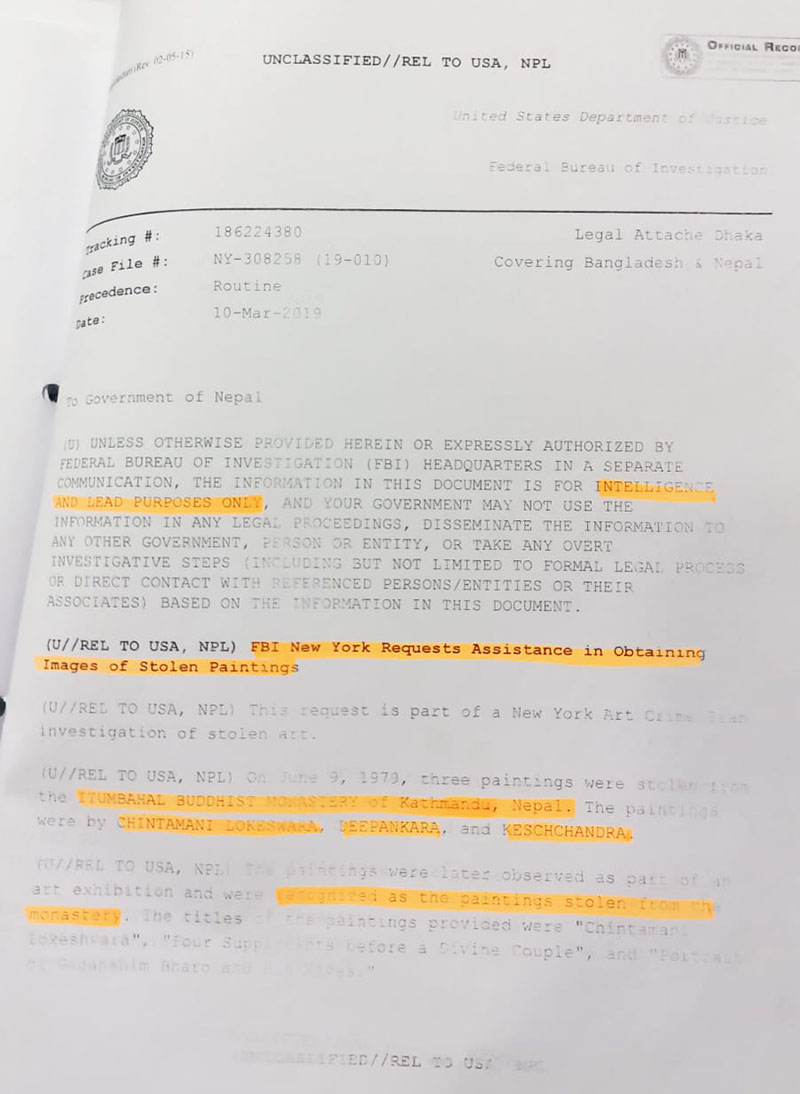
International investigative agencies have determined that Subhash Kapoor was involved in the theft and trafficking of these paintings. An indictment prepared in 2019 by the Manhattan District Attorney’s Office in New York, along with official documents from its Antiquities Trafficking Unit (ATU) and US Immigration and Customs Enforcement (ICE), clearly demonstrates that Subhash and his syndicate smuggled these idols from Nepal. Despite this, Nepal’s investigation into Subhash, his syndicate, and their operations within the country remains lackluster.
Charges against Subhash and his associates across 86 criminal counts have been filed in a US court. While his associates have already been convicted by the court, no final verdict has been delivered against Subhash, as he is currently serving a 10-year prison sentence in India. Alvin L. Bragg Jr., the attorney for the Manhattan District Attorney’s Office in New York, had led a decade-long investigation into the case.
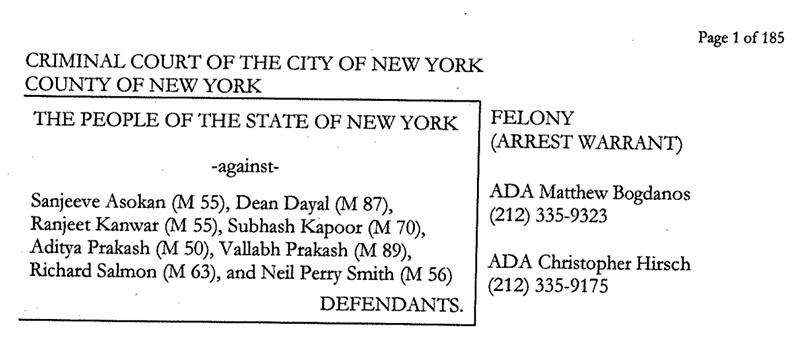
Similarly, US Homeland Security Investigations (HSI) has also conducted an in-depth investigation into this matter. According to HSI, a key channel for Subhash’s smuggling network, who operated a gallery named ‘Art of the Past’ in New York, was the Indo-Nepal Art Gallery located in Mumbai, India. This gallery was run by Vallabh Prakash, who had been living in Mumbai since 1959 and his son Aditya. They were arrested by US Immigration and Customs Enforcement on November 30, 2016 and have already been convicted by a New York court.
According to US Homeland Security Investigations, Subhash’s network spanned across Nepal, India, Afghanistan, Cambodia, Thailand, Bangladesh, Dubai, Hong Kong, Indonesia and Pakistan. Their method of theft was also unique. They would first visit temples and cultural heritage sites to conduct detailed observations of ancient idols. Once they identified idols that would command high prices in the international market, they would manufacture replicas that perfectly matched the dimensions, size and design of the originals. Seizing the right opportunity, they would steal the genuine idol and replace it with the counterfeit one. As a result, local residents and priests often remained unaware for years that their revered deity’s idol had been stolen.
According to the Antiquities Trafficking Unit (ATU) under the Manhattan District Attorney’s Office, Subhash’s network was so powerful that he smuggled more than 2,500 archaeological artifacts worth over $143 million into the United States alone. Manhattan District Attorney Alvin L. Bragg Jr. stated that Subhash operated this network for more than 20 years, from 1990 to 2011. The DA’s office reported that the investigation revealed 75% of the items sold from his gallery were stolen and illicit.
From Itum Bahal to the auction markets of Chicago
The painting of Gagan Singh Bharu that vanished from Itum Bahal ended up in the hands of New York-based art collector Navin Kumar in 1982. The Manhattan District Attorney’s investigation reveals that in 2003, this painting was put up for auction at the Art Institute of Chicago for $1 million (equivalent to 153.3 million Nepali rupees at current exchange rates).
In 2003, Stephen Truax Eckerd, the coordinator of Imagin Asia Family Programs at the Smithsonian Institution’s National Museum of Asian Art in Washington, D.C., spotted the Paubha paintings at the Chicago exhibition and identified them as belonging to Nepal.
Eckerd used to visit various parts of Nepal to study art and culture. During one such visit, prior to the theft of the Paubha paintings, he had observed and studied them right inside Itum Bahal. The photographs of historical heritage items he collected remain preserved in the Smithsonian archives.
As soon as he saw the Paubhas at the exhibition, Eckerd reported that they were stolen from Itum Bahal. He was well aware that those Paubha paintings had gone missing from Itum Bahal. Having a deep connection with Nepal, he later came to Kathmandu to inform officials that these paintings were in the United States and assured them that he would take initiatives to bring them back.
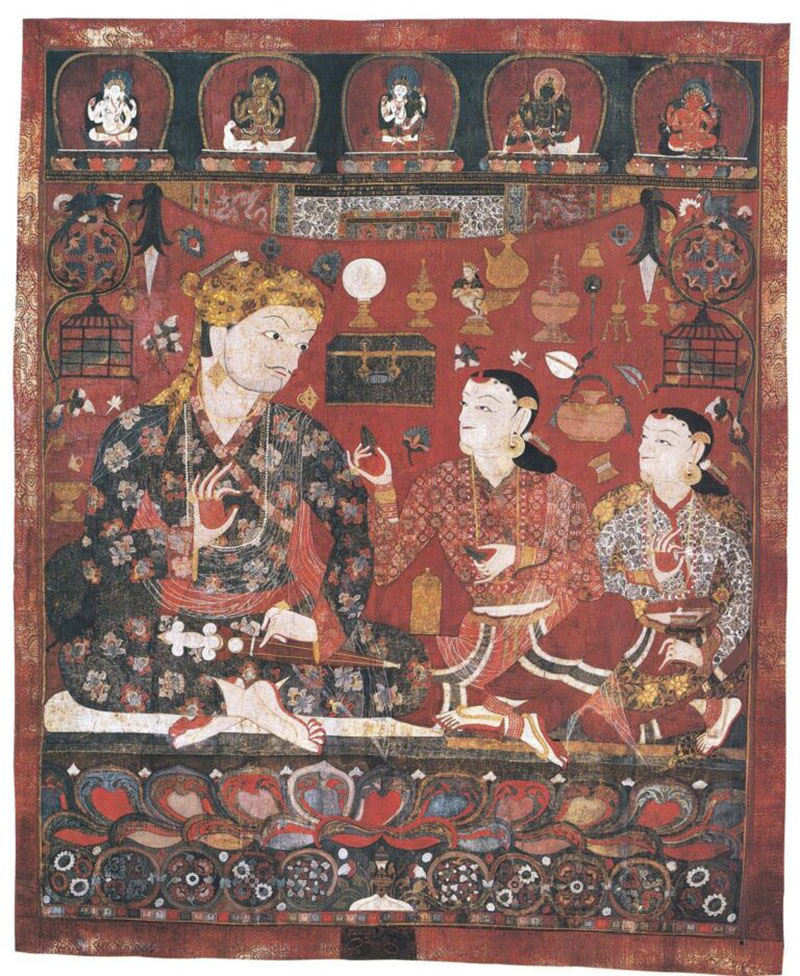
Photo Credit: Manhattan District Attorney’s Office
The books The Art of Nepal: Sculpture, published in 1974 by American art expert Pratapaditya Pal, and The Art of Nepal: Painting, published four years later, had analyzed Nepal’s artworks alongside photographs. Consequently, these paintings had already gained international recognition well before they were stolen.
According to a press release issued on March 7, 2025 by the Antiquities Trafficking Unit (ATU) under the Manhattan District Attorney’s Office, the historical painting of Gagan Singh Bharu and his two wives was illegally transported to Switzerland shortly after being stolen from Itum Bahal. It was kept there for about two years.
According to Sarita Subedi, an archaeology officer at the Department of Archaeology, Navin Kumar had initially refused to surrender the paintings even after they were confirmed to be stolen and illicitly trafficked into his possession. Following his refusal, the Antiquities Trafficking Unit (ATU) under the Manhattan District Attorney’s Office confiscated the Paubha paintings.
Major Cities Used as ‘Transit Points’
To transport Nepal’s ancient heritage abroad, smugglers do not rely on a single city. Instead, they turn major commercial hubs like London, Bangkok and Hong Kong into primary ‘transit points’.
According to the ATU, a 9th-century black stone Buddha statue that vanished from Bungamati, Lalitpur, in the 1970s ended up with a London art dealer a decade after its theft. The dealer then resold it to an American collector, and in 2015, the statue was put up for sale at the prestigious Christie’s auction house in New York. Ultimately, it was donated to the University of Michigan Museum of Art, from where the ATU seized it two years ago.
The ATU’s investigation reveals that the smuggling route for a stone idol from Kathmandu’s Bishnudevi Temple ran through Switzerland. In 1984, the idol was transported from Switzerland to New York, where it was purchased by the renowned New York art collector Robert Hatfield Ellsworth. A photograph taken nine years prior right inside the Kathmandu temple by Austrian architect Carl Pruscha became the strongest evidence proving the idol belonged to Nepal.
According to the ATU, a 10-armed Durga idol repatriated to Nepal on December 4, 2023 was discovered inside Subhash’s own warehouse. Subhash had purchased this idol from Bangkok and shipped it to New York some 20 to 22 years earlier.
Similarly, another 14th-century Durga idol stolen from a Kathmandu Valley temple was trafficked to the United States in the 1960s by Doris Wiener’s network. It was confiscated after resurfacing in the New York art market in 2022. Even after ending up in the hands of private collectors, traces of the vermilion and sandalwood paste applied by Nepali devotees were still visible on the idol.
The recovery process for this idol succeeded following an investigation into Doris’s daughter, Nancy Wiener, who was convicted on smuggling charges in 2021. Her mother has since passed away.
On June 24, 2026, the office repatriated two archaeological idols to Nepal, including a Padmapani that Wiener’s gallery had sold to Christie’s New York 14 years ago using falsified provenance documents. The investigation by the Manhattan District Attorney’s Office revealed that the Wiener mother-daughter duo had also traded idols with Subhash.
Similarly, a Bhairava mask stolen in the 1990s and trafficked to Hong Kong eventually made its way to the Rubin Museum of Art and the Dallas Museum of Art in New York. The pair of 16th-century gilt-bronze Bhairava masks are considered highly unique. Valued at $900,000 (equivalent to 138 million Nepali rupees at current exchange rates), these masks depict a manifestation of Lord Shiva, one of the three major deities in Hinduism.
A press release issued by the ATU on December 4, 2023 notes that four artifacts, including the Durga idol and the Bhairava mask, were recovered from Subhash Kapoor’s network. Ownership of these idols and Paubha paintings has now been restored to Nepal. Manhattan District Attorney Bragg expressed his pride in being able to return these heritage items, which were stolen from Nepal between the 1970s and 1980s. Historical photographs taken by Department of Archaeology photographer Chiniya Tamrakar and foreign experts served as the primary evidence proving these treasures belonged to Nepal.
Bragg shared his excitement that the long-term investigation successfully culminated in the return of these items. “These smuggling networks are extensive and complex,” he stated. “However, we will continue our work to dismantle them and remedy the damage they have caused.”
An oblivious Department of Archaeology
Statues, Paubha paintings and archaeological artifacts that went missing from Nepal decades ago are being discovered in foreign museums and private galleries. However, the Department of Archaeology remains completely unaware of how these priceless heritages reached abroad and who was involved.
We reviewed 12 research reports prepared by the department to repatriate the lost heritage. Although these reports emphasise the archaeological details and historical significance of the missing objects, they make no mention of the smuggling syndicates involved in the theft or their trafficking routes.
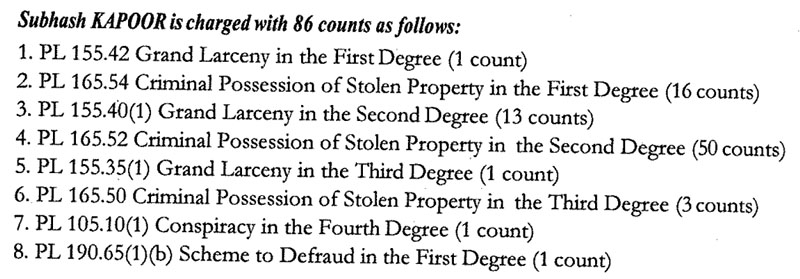
No investigation has been conducted regarding Subhash himself or the syndicates that assisted them within Nepal. Former Senior Superintendent of Police Hobindra Bogati, who worked at the Nepal Police’s Central Investigation Bureau (CIB), states that investigating the theft of art and archaeological artifacts is extremely difficult. According to him, a dedicated unit must be established for this purpose. “The police have not been given any responsibility other than playing a coordinating role in bringing stolen heritage back to Nepal and managing the repatriated heritage,” he said.
Sarita Subedi, an archaeological officer at the Department of Archaeology, stated that because Subhash was convicted of smuggling artifacts and is currently in an Indian prison, and since the United States has requested his extradition, Nepal does not need to do anything.
CIB spokesperson Anupam Shamsher Rana says that they will proceed with an investigation only if requested by the department itself.
During the period when statues and heritage were disappearing from Nepal, foreign researchers and art experts had exposed the smuggling networks, yet Nepal is not found to have taken any initiatives to stop it.
In an article by art expert David Sassoon, included in the 1989 book The Ethics of Collecting Cultural Property: Whose Culture? Whose Property? edited by Phyllis Mauch Messenger, it is alleged that not only European and American art experts but also diplomatic mission employees, foreign ambassadors and their families were involved in the theft of Nepal’s statues and archaeological objects. He wrote that high-ranking foreigners abused diplomatic privileges to safely transport Nepali artifacts abroad. In many instances, these artifacts were sent directly out of the airport as ‘diplomatic cargo’, which customs and security agencies were not permitted to inspect.
Even though the deities of Itum Bahal have returned home after 45 years, thousands of other ‘gods and goddesses’ are still waiting for justice in the cold basements of foreign museums.
According to the records of the Department of Archaeology, 201 statues and archaeological artifacts have been repatriated to Nepal from various countries between 1985 and the present. However, this number is minuscule compared to the amount of stolen heritage. The department has received official complaints regarding the theft of 409 archaeological artifacts.
According to the Department of Archaeology, there are still 99 such statues for which claims and evidence have been verified, but their return is pending. These heritages are currently housed in museums in France, Sweden, the UK, Switzerland, Singapore, the US, Australia and Beijing, China. Following the rise of democracy in Nepal after 1950, the influx of foreigners increased and it was from that time onward that the theft and export of archaeological objects intensified. The state possesses no official data on how much heritage was smuggled out prior to 1950.
The most distressing aspect of heritage theft is that objects vanished from within tight security perimeters. The necklace of Taleju Bhawani in Hanuman Dhoka, which should have been under strict security, was stolen and later discovered in the Art Institute of Chicago museum in the United States.
Not only that, the disappearance of an ancient copy of the famous Islamic text Shahnama from inside the Chhauni Museum (National Museum) raises significant questions about the government security apparatus. The loss of archaeological objects from a sensitive place like a museum underscores just how vulnerable our open heritage sites, located in temples and monasteries, truly are.
Basis for the repatriation of Paubha paintings
After the priceless 15th-century paintings were stolen in 1980, Itum Bahal’s half-century-old cultural festival came to a halt. The regular celebrations were discontinued after the Paubhas, which used to be displayed to the public for 15 days during the Gunla festival, went missing. Chandra Bahadur Shakya, the then-chairman of the center, filed a complaint along with photographs at the Janasewa Police Station, the Department of Archaeology and airport customs. However, a fire broke out at the police station shortly after, reducing the case file to ashes. The search process had to start from scratch once again.
A photograph taken by Chiniya Tamrakar, a photographer for the Department of Archaeology, and the activist group ‘Lost Arts of Nepal’ became milestones in identifying and repatriating these heritages. The black-and-white photograph taken by Chiniya two years before the theft served as international-level proof that these items belonged to Nepal.
The activist group ‘Lost Arts of Nepal’ worked to identify these objects that had reached foreign museums and to raise public awareness. Photographs published in Lain Singh Bangdel’s 1981 book, Stolen Images of Nepal, also provided immense help in identification.
In February 2020, a team led by Faria M. Jimenez from the US Federal Bureau of Investigation (FBI), along with CIB officials, visited Itum Bahal. Pragya Ratna Shakya, the current chairman of the center, says, “Since the evidence was verified, they gave us hope that the Paubha paintings would be returned, but the subsequent two years of silence left the locals disappointed once again.” It was only two more years later that another investigation team from America arrived in Nepal.
The legal process for repatriation moved forward in accordance with the 1970 UNESCO Convention. The convention stipulates that stolen or illegally exported cultural property must be returned to the concerned nation based on official evidence. Since managing the budget through government processes would take time, a fundraising drive was conducted under the leadership of Bijay Man Singh, president of the Newah Guthi New York. Utilizing those collected funds to cover shipping expenses, three Paubhas and 17 statues were brought back to Nepal on March 11, 2025. The New York Attorney General had handed over these items to the Acting Consul General, Chakra Kumar Subedi. The monetary value of these heritages is estimated to be around 430 million Nepali rupees.
According to data from the Department of Archaeology, 72 archaeological artifacts have been repatriated from the United States so far. Legal professional Sanjay Adhikari notes that while collaborating with the Manhattan District Attorney’s Office has eased the return of heritage from the US, legal complexities remain regarding the repatriation of objects currently held in France and the Los Angeles County Museum of Art. He adds that even though the deities of Itum Bahal have returned home after 45 years, thousands of other ‘gods and goddesses’ are still waiting for justice in the cold basements of foreign museums.
More than 600 Nepali artifacts under investigation at Rubin Museum
In September 2010, during a program organized in Kathmandu, Adam Swart, a representative of the New York-based Rubin Museum, claimed that his museum housed a massive collection of Himalayan art. Surprisingly, six of the artifacts he showcased belonged to Nepal, which he admitted to acquiring from a ‘French collector’.
According to heritage conservationist Rabindra Puri, discovering statues and artifacts stolen from Nepal at the Rubin Museum is nothing new. The figure of a garland-bearing Apsara (Vidyadhara), which went missing from Itum Bahal in 1999, ended up in the Rubin’s collection four years later. The Rubin Museum came under pressure only after ‘Lost Arts of Nepal’, a group that tracks heritage through social media, identified the Vidyadhara.
Puri states that after returning the Vidyadhara in March 2022, the Rubin Museum increased its proximity to Itum Bahal. The Rubin has provided 20,000 USD in assistance for constructing a museum at Itum Bahal. However, he views this assistance with suspicion. Questioning why the Rubin would provide money to open a museum at Itum Bahal while showing little interest in returning other stolen Nepali artifacts in its possession, he remains skeptical.
Meanwhile, Pragya Ratna Shakya, the chairman of the museum, explains their constraint, stating they had to accept the assistance due to a lack of budget for conservation. “Our statues have been stolen and reached abroad. We needed a museum to protect them but we didn’t have the budget. That is why we had to accept the help,” he says.
NIMJN had corresponded with the Rubin Museum on April 26, 2026 to request information regarding the Nepali heritage housed there. According to Sandrine Milet, head of communications and marketing at the Rubin Museum of Himalayan Art, the institution has collaborated with the Keshchandra Mahavihar Conservation Society (Itum Bahal) on its museum establishment project.
The museum has been providing support in the cataloging, documentation and exhibition management of heritage. According to her, a special exhibition section has also been set up at the museum to raise public awareness regarding the illegal trafficking of art from Nepal.
According to her, the museum has a policy against acquiring stolen or looted cultural heritage. Stating that research is currently underway regarding the provenance and ownership history of more than 600 objects identified as originating from Nepal, she affirmed that the institution is committed to returning any object proven to be stolen or looted to its country of origin.
Acknowledging that they are sensitive to the questions raised by Nepali heritage activists regarding the Rubin’s role, the museum stated it will maintain an open dialogue with stakeholders, including the Nepal Heritage Recovery Campaign.
According to conservationist Rabindra, international markets have set up shops using our heritage under the guise of ‘Asian Art’ and ‘Nepal Sections’. He notes that under international law, if a country can prove that the heritage belongs to them, provisions dictate that the items must be automatically returned.
Sometimes, mere widespread publicity about a theft prompts museums to return heritage just to protect their reputation. Not only the Rubin, but a strut (tundal) stolen from Itum Bahal was also returned from the Metropolitan Museum of Art in New York. The finest Licchavi and Malla period artworks of Nepal are on display in these major museums.
Temporary exhibitions of heritage: A gateway for heritage theft
Efforts to internationalize Nepali art and archaeological artifacts appear to have begun with great vigor during King Mahendra’s reign from 1954 to 1971. At that time, with the aim of introducing Nepal’s exquisite artworks and archaeological objects to the world, artifacts were sent through the Department of Archaeology for exhibition at the Asia House Gallery in New York, USA.
In an article titled ‘Art Historian, Statue Thief, or Both?’ published by historian Mahesh Raj Panta in Himal Khabar, it is mentioned that those artworks were sent under the direct interest and direction of King Mahendra himself. The detailed catalog of artworks prepared for that exhibition has now become the strongest historical document to prove that those heritages belong to Nepal.
This series of exhibitions was not limited to America alone. According to the book Statue Theft: A Complex Problem published in 1992, the then His Majesty’s Government and the Department of Archaeology organized exhibitions of Nepali art across France, Germany and the United States between 1966 and 1977.
Coinciding with King Mahendra’s visit to France in October 1966, a major exhibition of Nepali artworks was held in Paris. While the catalogs published in memory of that historic journey served to advertise the uniqueness of Nepal’s Licchavi and Malla period craftsmanship to the global market, they simultaneously ended up drawing the attention of smugglers toward Nepal.
With the arrival of democracy in 1950, Nepal opened up to the outside world. The easy entry of foreigners and the growing fascination of international collectors with Nepali art led to an alarming rise in the illegal sale and smuggling of our rare manuscripts, ancient inscriptions and statues. After official government-level exhibitions established the market value of Nepali heritage on an international scale, facts have begun to emerge showing that, in some instances, there was negligence in the security of items taken for exhibition, and some were even made to vanish from there.
During this period, not only were open heritages in Nepal’s temples and monasteries lost, but even objects under state protection that should have remained within tight security perimeters were smuggled out. This wave of ‘art drain’ that began in the 1960s evolved into an organized international crime by the 90s.
Historian Prof. Dr. Mahesh Raj states that although the catalogs from those exhibitions held during King Mahendra’s reign are currently helping to locate missing statues, those very exhibitions put Nepali heritage at risk.
The ordeal of heritage repatriation
The 1970 UNESCO Convention sets a mandatory provision that stolen archaeological artifacts must be returned to their country of origin. In Nepal, the process of tracking and repatriating these items is incredibly lengthy. Following a complaint from stakeholders, the Department of Archaeology collects evidence and prepares a report. This is then routed through the Ministry of Culture to the Ministry of Foreign Affairs, and finally to the diplomatic mission of the concerned country.
However, according to the head of the department, Saubhagya Pradhananga, diplomatic dialogue and the submission of evidence is a tedious process. An even bigger problem is created by the lack of budget. Even after an object is proven to belong to Nepal, the repatriation process takes much longer than expected due to insufficient funds for shipping and other administrative expenses. She added that reinstating the returned heritage to their original locations is even more challenging.
According to the Ancient Monument Preservation Act, 1956 and Article 47(d) of the Constitution, the protection of public property is the responsibility of both the local community and the state. The department hands over the heritage only after a full guarantee of protection is secured through the recommendations of the local level and the District Administration Office, and a formal undertaking is signed.
Cover Photo: Three Paubha paintings of Itum Bahal repatriated on March 11, 2025. Photo courtesy: Pragya Ratna Shakya
Please adhere to our republishing policy if you'd like to republish this story. You can find the guidelines here



Comments